The State Bar of California has announced an updated layout and design for its sample MCLE Activity Evaluation Form, effective March 1, 2026. The revision concerns formatting and presentation only. The core evaluation questions and required content areas remain unchanged.
For organizations seeking or maintaining CLE accreditation in California, this development is primarily procedural. However, it provides an appropriate moment to revisit internal compliance systems and confirm alignment with current State Bar rules.
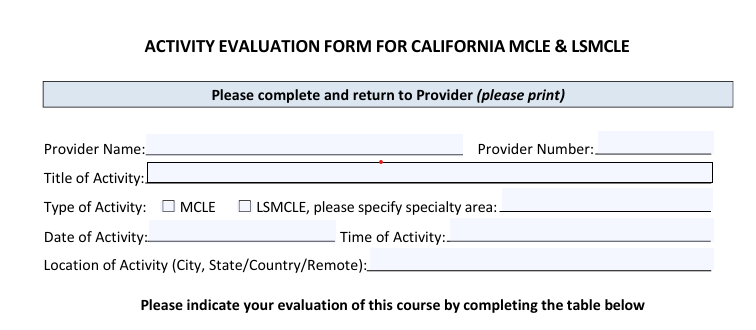
Table of Contents
Rule 3.602(E) and Evaluation Obligations
Under Rule 3.602(E) of the State Bar Rules governing MCLE providers, all providers must provide each participant who completes an MCLE activity with a State Bar MCLE Activity Evaluation Form or its equivalent. Providers must retain completed evaluation forms for at least one year and submit them to the State Bar upon request.
The updated sample form continues to collect:
- Provider and activity information
- Activity type and delivery format
- Participant feedback regarding course quality
- Instructor effectiveness
- Whether the program met the participant’s educational objectives
Providers may continue to use the State Bar’s sample form or adapt the content into their own format, provided the evaluation captures the required information and remains consistent with Rule 3.602(E).
Attendance and Record Retention Requirements
Evaluation compliance operates alongside broader CLE accreditation obligations.
For participatory MCLE activities, attendance must be recorded using the State Bar’s Record of Attendance Form or an equivalent document. Attendance records must be retained for four years from the date of the activity.
In addition, providers must submit electronic attendance records to the State Bar within 60 days of completion of a participatory activity. These reporting timelines are separate from evaluation retention requirements and should be tracked independently.
Certificate Issuance for Participatory and Self Study Activities
Certificate issuance is another essential component of CLE accreditation compliance.
Providers must issue:
- An MCLE Certificate of Attendance or LSMCLE Certificate of Attendance to participants who meet the requirements of a participatory activity
- An MCLE Certificate of Completion or LSMCLE Certificate of Completion to participants who satisfy the requirements of a self study activity
Certificates may be delivered in written or electronic form. Clear internal procedures should distinguish between participatory and self study formats to ensure the correct documentation is issued.
Common Compliance Gaps in CLE Accreditation
Although the recent update does not change substantive requirements, compliance gaps frequently arise in practice. Examples include:
- Using evaluation surveys that omit required feedback areas
- Failing to retain completed evaluation forms for the full one year period
- Treating evaluation distribution as optional for certain delivery formats
- Overlooking the four year attendance retention requirement
Because Rule 3.602(E) applies to each participant who completes an MCLE activity, evaluation distribution should be built into standard program workflows rather than treated as an administrative afterthought.
Practical Considerations for Providers
For organizations that regularly pursue CLE accreditation, the updated evaluation form provides an opportunity to conduct a structured review of:
- Evaluation templates
- Attendance tracking procedures
- Electronic reporting timelines
- Certificate language and format
- Record retention systems
Our consulting services support providers at each stage of the CLE accreditation process. We review course materials to ensure consistency with jurisdiction specific rules, submit accreditation applications where required, communicate with MCLE regulators, and guide providers once approval is confirmed. We also assist with attendance reporting and documentation practices so that evaluation and retention obligations are addressed in a systematic manner.
Planning a continuing legal education program involves substantial coordination. Ensuring that CLE accreditation requirements are properly implemented helps protect both the provider and the attorneys who rely on receiving accurate credit. Even when regulatory updates involve formatting changes rather than substantive revisions, they serve as a useful reminder to verify that compliance procedures remain aligned with governing rules.